Showing posts with label Chinese American history. Show all posts

September 08, 2015

Sacramento Delta Trip Part III: Isleton, CA

Sign for historic Main Street in Isleton, CA

A few weeks back, we took a trip to the Sacramento River delta towns of Locke, Walnut Grove, and Isleton, CA.  This post documents our exploration of Isleton.  Like Walnut Grove, Isleton once had a substantially large Chinatown and Japantown.  Ethnically speaking, this town's claim to fame is the Bing Kong Tong building, a colorful structure that was featured on the PBS series, History Detectives.

Entering Isleton, you notice that you drive through the "good" side of town first.  Homes here have manicured lawns, well-tended front yard gardens, and the quintessential white picket fence.  Then, as you cruise down historic Main Street, the scenery progressively becomes "seedier" with more character and noticeable structural decay--this is where the town's businesses are located.  Isleton's Chinatown and Japantown are located at the end of Main Street, away from the white part of town.

 Entering Isleton: the "good" part of town 

Driving down old Main Street 

Driving down Main Street, old and dilapidated buildings catch one's eye--some with new businesses, others are remnants of buildings locked up and closed.  Many cars were parked in spaces, but few people were seen on the streets.  The feel of Isleton is that you are stepping back in time (minus the modern cars and businesses), but tourism is less prominent a feature here than in Locke and Walnut Grove.  We instead felt out of place as tourists.  An ominous feeling pervaded, like we were foreigners who were tolerated by the town's locals.  (FYI: my photos of the non-Chinatown area were taken while driving.)

The "seedier" part of Isleton
Lots of rustic character = neat photos


When we arrived in the Chinatown, we parked and stepped out.  For history lovers, the Bing Kong Tong (see below) may be the main attraction here on Isleton's Main Street.  Background: the Tong Wars were fought between rival tongs (aka Chinese gangs) in the pre-1920s era throughout the West Coast.  Interestingly, Tong buildings operated as community centers, but were basically a commercial front for gang activities.  This pre-1920s time period was like the Chinatown Wild West, since it was before families could establish in the US due to anti-Chinese laws (it was not until the early 1950s that this changed).  The fact the Isleton has a Tong building shows that the Chinese community here was once thriving.

 
featured on the PBS series, History Detectives

According to the signage next to the Bing Kong Tong, the historic renovation has largely been an ongoing process.  Peeking into one of the windows, one can see modern wooden support beams and insulation added to preserve the building's structure.  The signs below detail, in a scholarly way, both Chinese American and Japanese American history in Isleton and the surrounding area.  

Note the metal walls--
this choice in outer building material was because it is a fire deterrent

Isleton's Japantown and Chinatown history is stated in the informative panels above.  
If you are interested in reading the information here, I took a close-up shot of each panel. 

A colorful Chinatown building

Chinatown buildings; same colorful one as above
(photo taken from across the street)


Where are the Japantown photos?
We drove through Isleton to find its Japantown, but it appears that few buildings are now labeled as such--or at least to those who casually drive by.  Due to this, and the feeling of being a foreigner (with stares from locals), we did not pursue an exploration of the adjacent Japantown.  There was a temple, I believe, down a side street that we saw while cruising by.


 Sidewalk near the Chinatown and Japantown areas 

The lighting was harsh in mid-day and the weather hot, but the photos here captured the desolation and solitary small-town feel that we experienced in Isleton.  

Afterthoughts:
Looking back, my favorite photos from this Sacramento River delta-towns trip were from Isleton--although we did not exactly feel welcome there as tourists.  The run-down buildings, abiding stillness, and various states of decay left an imprint on me, a belated gift from this tiny rural town.

Locke and Walnut Grove were more exciting and fun to explore on foot, and were undoubtedly more tourist friendly.  It is not a surprise that I enjoyed the visit to each town for different reasons: Locke for its rich ethnic history and decaying, funky feel; and Walnut Grove for its quaintness and warmth, plus its history.

For history buffs, each town--Walnut Grove, Locke, and Isleton--offers something slightly different and unique to the visitor, although the drive is all but 10 miles apart.  A trip to all three towns can be completed in a few hours, and is worth the drive.  Highly recommended if you love rural life, historic sites, and wandering around semi-deserted towns.

Links:
- History of the Tong Wars:
https://en.wikipedia.org/wiki/Bing_Kong_Tong
- Isleton Chamber of Commerce:
http://www.isletoncoc.org
- Historic Chinatown and Japantown in Isleton:
https://en.wikipedia.org/wiki/Isleton_Chinese_and_Japanese_Commercial_Districts
- California's old Japantowns:
http://www.californiajapantowns.org/profiles.html
http://www.japantownatlas.com
- A cool Flickr feed of Sacramento delta towns:
https://www.flickr.com/photos/whsieh78/albums/72157626067277853


* * *

Part 1 of this Sacramento delta trip to Walnut Grove can be read here.
See Part 2, our trip to Locke, here.

August 30, 2015

Sacramento Delta Trip Part II: Locke, CA

A few weeks back, we took a trip to the rural Sacramento River delta towns of LockeWalnut Grove, and Isleton, which are about 30 miles south of Sacramento.  This post documents our trip to Locke, a historically significant place in that it is the only all-Chinese town in the United States--and not an ethnic enclave of Chinatown within a town or city.  Specifically, Locke is unique in that it was a town built from the ground up by the Chinese for their own community.

Bitter Melon by Jeff Gillenkirk and James Motlow
An oral history, with photographs, of Locke's first residents


History:
The town of Locke was first settled by Chinese immigrants in 1915 after a fire ravaged the Chinatown in nearby Walnut Grove.  Over the years, descendants moved on for better opportunities; now there are fewer than 10 Chinese American residents in Locke.  A designated historical landmark, the town does have some thriving long-time businesses, notably Al the Wops (a popular biker bar) and Locke Garden (a Chinese restaurant).  Locke's centennial was celebrated this past May.

What you will find there: original 1910s-1920s architecture, remnants of old gambling/prostitution establishments (via doorways and signs), a few museums, natural decay--and many cats.


Below are photos I took in Locke:

View from one end of Main Street
(in front of the old schoolhouse) 

The above image shows roughly 1/3 of Locke's Main Street, which is (and was in the past) the commercial district.  A church is located on the next street over in a residential area.  FYI: Beyond Main Street are private homes, so be respectful and do not trespass.


One of the alleyways on Main Street

Locke has a few of these wooden floorboard alleyways on Main Street that are overgrown with lush plants.  The alleyways lead via staircase from Main Street to the two-lane highway (which is on a levee), as shown in the above image.  Smaller, less decadent pathways are on side streets that run parallel to Main, and were used as shortcuts within the town.


The famous toilet garden (a great story)

The toilet garden:
As the Chinese moved out or died, Locke's houses were sold to whites.  Ironically, the new owners wanted the Chinese houses but not their "tainted" toilets, so they threw them out.  The late Connie King, who was Locke's unofficial mayor and a second-generation Chinese American, took these toilets and in a subversive act against racism, made something "pretty" with them: a toilet garden.  This garden she prominently displayed in town on a side road near her home.

Connie King was an amazing woman, a tireless community activist who fought to preserve the history and integrity of the town--and for good reason.  King married a Locke resident, raised her children in town, and, in 1990, was integral in securing historical landmark status for Locke.  Moreover, King fought for the Chinese to own their own land in Locke (read the story in the next paragraph).  Ironically, her husband, a Chinese American WWII vet, was at the time not legally allowed to purchase or own land due to race.  Connie King passed away in her sleep in 2009.

There is a troubling backstory about home ownership in Locke.  Due to anti-Chinese laws and Locke being privately owned until 2001, the Chinese were not allowed to own their own land until 2004-2005.  It was then that the Sacramento Housing and Redevelopment Agency, whom the private owner sold Locke to, parceled up the land to sell.  Consequently, from 1915 up until the mid-2000s, purchasing a home in Locke meant that you owned the home but not the land that it sat on.  (This article sums up the story well).

Back to our trip:
When we were photographing the toilet garden, an act of serendipity occurred.  A hippie-ish man in his fifties or sixties, who was unpacking items from his car nearby, began talking to us about the garden.  It turns out that he is James Motlow, the photographer of the definitive book on Locke, titled Bitter Melon.  The book is now in its 6th edition printing for Locke's centennial this year.  Part oral history and part haunting photographic exploration of the interviewees, Bitter Melon is a worthy read and a unique snapshot in time.  Motlow now lives in Connie King's old house, which is across the gravel road from the toilet garden.


A view of the Main Street buildings from the highway 

From the photo above, one can see where the top of a Main Street alley's stairway leads to: a business-type space complete with a porch, overhang, and walkway to the highway.  These old storefronts are the second stories of the buildings seen on Main Street.  Interestingly, the false facades still bear remnants of old painted-on business names.  Behind the photographer is the 50 mph two-lane highway atop the levee; on the other side of the highway-levee is the Sacramento River.

Side note: This tight highway-river-town layout leaves no room for error: one wrong steer and you are on the shoulder of the highway, or worse yet, in the Sacramento River.


Dai Loy Museum (gambling house)

All the museums were closed when we visited, except the schoolhouse.  The above image is of the Dai Loy Museum: a gambling house.  Note the bright green arched entryway right behind the museum sign, which indicates the location of a business establishment for thrill seekers.  On other buildings, some of these arched entryways lead to a door with a lamp above it--likely houses of ill repute, or at least so when Locke was a thriving ethnic community.


Center of Main Street

The building to the left is nearly falling over, and is etched with names and dates of visitors on its front wall.  Across the street is famous biker bar, Al the Wops.  Loud music was heard blaring when the doors opened.  Above the sidewalk are occasional overhangs whose shade makes the Valley heat more bearable.


Old storefront sign under an overhang:
"Wah Lee Boots Dry Goods"

Currently, the majority of Main Street's buildings are boarded up or used as storage.  Around 1/4-to-1/3 of the buildings are current businesses, the majority of which were closed on our visit.


Afterthoughts:
This was not my first trip to Locke, however, it was my first in nearly a decade.  On my first visit to Locke nearly a decade ago, the mood of the town then was oddly New Age-y, but a sense of excitement could be sensed in the air: Connie King was still alive at that time (I remember seeing her), and Locke's residents had finally been able to own their land for just three years.

Now, in 2015, the old boarding house is a California State Park, and with it came, in my opinion, a renewed interest in preserving Locke's ethnic history.  The feel of Locke in 2015 is ever-so-slightly tourist-y and less influenced by the New Age aesthetic; its capitalistic allure more so the Chinese aspect (and the romanticism that accompanies it) and Al the Wops than a crumbling quirky old town.  The buildings are decidedly shabby and in disrepair; the town is overrun by cats; the chubby town dog has since passed; Connie King is gone--but something remains in Locke that I hope will never leave: a sense of struggle and continuance in a changing world.

Links:
- Locke's National Park Service site:
http://www.nps.gov/nr/twhp/wwwlps/lessons/locke/locke.htm
- Main website for Locke:
http://www.locketown.com
- Locke Foundation:
http://www.locke-foundation.org
- Purchase the Bitter Melon book:
http://www.amazon.com/Bitter-Melon-Inside-Americas-Chinese/dp/0578155893


* * *

Part 1 of this Sacramento delta trip can be read here.
See Part 3 on Isleton here.


August 23, 2015

Sacramento Delta Trip Part I: Walnut Grove, CA

A few weeks back, we took a trip to the rural California delta towns of LockeWalnut Grove, and Isleton located about 30 miles south of the state's capital along the scenic Sacramento River.  You cross the highway and there is the river beyond a 10-foot levee: both towns are only 10 feet above sea level.  This post documents our trip to Walnut Grove, with some history thrown in.

Sign in Walnut Grove indicating the old Chinatown and Japantown

History:
In the early 20th century, the town of Walnut Grove was home to a thriving Chinatown, and even boasted a large Japantown.  These communities shared a border due to racial segregation.  However, a Chinatown fire in 1915 provided the impetus for many in the Walnut Grove Chinese community to move--and move they did, a mile away, and built the tiny town of Locke from the ground up (see my next blog post).  Another fire in the '30s wiped out Chinatown yet again.  The Japanese American community in Walnut Grove, on the other hand, never burned down and instead became a cultural hub.  Yet after Japanese American relocation and internment during WWII, the population shifted; as later generations moved to urban areas for better opportunities, Japantown adapted.  According to this site, today there are still some ethnic businesses and a JA community in Walnut Grove. 
    
Below are some photos I took on our trip to this historic town:

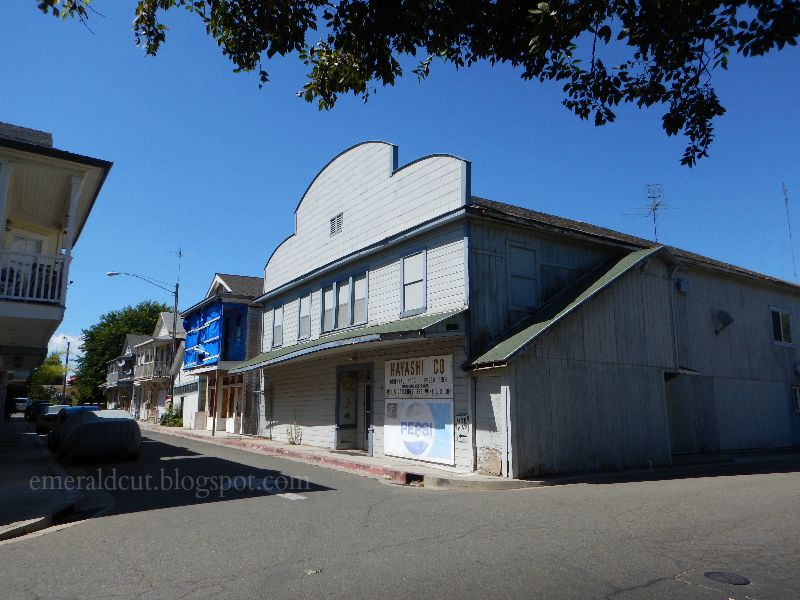
Hayashi Co. (market)
Located on the corner of Tyler and B. Streets; next to the public parking lot.
It appears that the storefront is still used--the phrase "productos Mexicanos" is visibly adhered under the bolded old shop name on the sign.


Kawamura Barber Shop
First opened in 1916 by an Issei (first generation), the owner's daughter continued her father's business until at least 1993--signs inside the shop note its history.  Looking into the window of this once-business was like stepping back in time: modern appliances can be seen among early 20th-century decor.


Front of Kawamura Barber Shop 
(Chinatown is behind the photographer)


Chinatown buildings
Note the repainted Chinese Freemasons sign above the pale-green doorway of the yellow building.  I am unsure if these buildings were built prior to the 1915 and 1930s fires, but the buildings do indeed look old.  Mainly businesses (art studios, restaurants, etc.) line this street, and all appeared closed--or the doors were closed due to midday heat.


Afterthoughts:
Walnut Grove is a tiny tourist-friendly town without the tourist feel.  We really enjoyed the trip, and spent over an hour just taking it all in.  The streets of the historic districts shown here were mostly free of people; few cars lined the curbs.  Some restaurants were open, but otherwise the town was fairly quiet, which was perfect for exploring and taking one's time photographing the immediate area.  As for parking, the Japantown and Chinatown were a short walk from the designated parking lot, but a Japanese temple and a few other buildings are on other streets (see map here).  It was neat seeing the modern uses of the old buildings, but finding the Kawamura Barber Shop was the highlight of the trip, as it was a unique snapshot in time.  Japantown now appears to be a residential area, so we kept our voices down.  This town is definitely worth a visit if you are interested in history and rural, small town life: population 1,500.

Note: There is a short bridge that can be accessed slightly south of Walnut Grove to cross the river.


Links:
- Walnut Grove/Locke tourism: 
- Informative site on California Japantowns:
http://www.californiajapantowns.org
- Helpful Japantown maps:
http://www.japantownatlas.com


* * *

See Part 2, our trip to Locke, here.
Read Part 3 on Isleton here.


August 23, 2014

1860s Oroville Chinese Temple

Oroville Chinese Temple (1863)
 in Oroville, CA (located at the Sierra foothills)--
image from NoeHill.

Earlier this summer, we visited the historic Oroville Chinese Temple.  The information provided in this post is from my own experience coupled with information found in the Oroville Temple brochure.  All photos are my own except for the one above.

Temple History:
The Oroville Chinese Temple originally served as place of worship for the sizable mid-19th-to-early-20th-century Chinese American population (estimated at 3,000 to 10,000 people) in Oroville.  This largely immigrant population was comprised mainly of laborers, but also included merchants and their families (some of whom were born in the US), thus creating a Chinese American community, or Chinatown, in Oroville.  

In 1907, an Oroville flood badly damaged the once-thriving Chinatown that surrounded the temple.  As a result, the Chinese American population began a mass exodus to metropolitan areas, such as San Francisco and Sacramento, where there were established Chinese American communities and work was more plentiful.  The Chinese Temple in Oroville was eventually deeded to the city of Oroville in 1937.  It was only in 1949, after restoration work was started by the Oroville Women's Community Club, that the Chinese temple was again open to the public.  

Now, the historical temple functions mainly as a comprehensive museum, which boasts an impressive collection of of historical relics with vast relevance for Chinese American, Gold Rush, and California-specific history.  Beyond the temple/museum, two other buildings, and a few plaque markers and outdoor artifacts, Oroville's Chinatown is now long gone.  


Plaque marker noting the site's
historical significance.

The Anti-Chinese Movement:
During this time period, vehement racism against the Chinese in America culminated in the passage of two historic anti-Chinese laws that severely restricted the legal entry of this racial group to the United States: Chinese Exclusion Act (1882-1943) and its predecessor the Page Law of 1875 (the latter of which excluded the immigration of Asian women to the US, but was aimed primarily at Chinese women).  Historically speaking, these two laws are notable in that they were the first-ever US laws whose specific target was a racial group as a whole.  As a result, the Page Law and the Chinese Exclusion Act set a historical precedent for race-based immigration to the US, whose legacy is the immigration quotas we know today.  The anti-Chinese movement, which was dubbed the Yellow Peril, or the irrational fear of an Asian invasion and takeover of white America, fueled the renewals (and the subsequent permanency) of the Chinese Exclusion Act until the law's eventual repeal in 1943.  These race-based laws were enacted on a local as well as national level through both legislation and anti-Chinese sentiment, which collectively affected all Chinese (both immigrant and American born) residing in the US.

The Temple Grounds:
Rather unassuming, the Oroville Chinese Temple is actually comprised of four original rooms (three for worship), plus a large tapestry and clothing/artifact display hall that itself spans three rooms, as well as a replica of an 1860s Chinese worker's hut, a courtyard garden, and the Fong Lee Room (the newest addition, which was built in 2008 as a gift from the descendants of the founding Chin/Chan family).  

The Chan Room 

Initial Thoughts:
Unaware of the once-booming Chinese presence in Oroville, I was amazed at how comprehensive the temple grounds were, including the sheer number of cultural relics displayed and the large size of the complex, itself.  Additionally, the structural upkeep by the city of Oroville is commendable.

The museum docent was a middle-aged woman who gave off a hippie-meets-New-Age vibe.  She eyed us a little warily at first, presumably because I wore a large backpack and we touted cameras.  She soon did warm up to my presence while I waited in the gift shop/museum entrance for my husband, who kindly went to stow my backpack in the car.  Note: Security cameras are installed in every room of the complex, as well as in the courtyard, and are religiously monitored by the museum docent in the gift shop room.  If you take photos, flash is prohibited in order to preserve the artifacts.


The Self-guided Tour:
Beyond the gift shop, the first room that we toured was the main chapel (not shown here).  The main chapel was built in 1863 after burning down twice before, which makes it the oldest surviving room in the temple.  Relatively untouched over the years, beyond some odd hippie-ish decorations that were added to the altars, in the room sits numerous 19th-century religious cultural artifacts that are very dusty and paper-thin delicate with age.  In this room, one can perceive and feel its extensive historical significance by merely walking into it.

The Chan Room, the second room of worship, can be accessed without having to enter the temple complex.  To visit the Chan Room, enter to the open door to the left of the museum entrance.


Chan Room relic from the mid-to-late 1800s.

In the middle of the museum/temple sits the courtyard, which is filled with Chinese plants and a small fish pond.  A small garden in a traditional layout remains, and guests can sit on benches that hold plaques with donors' names on them.  This courtyard separates the tapestry room from the four original rooms.


Garden inside the complex walls with Chinese plants,
as seen from the second story.


The staircase can be accessed from the courtyard to view the Moon Temple (not shown), which showcases a unique moon-shaped brick doorway entrance to the temple room.  Structural issues can be seen here, and the ground is a little unstable underfoot--we tread lightly here, and didn't linger for too long.


Staircase to the upper level where the Moon Temple
(not shown) is housed.


View from the upper level,
where a modern security camera can be seen. 


Directly below the Moon Temple, on the first floor, is the Council Room, which held the most varied historical items: marble-seated chairs, pagoda-style altars, tables, and books that displayed handwritten documentation.  Just as the name states, the Council Room served as a civic center for Oroville's Chinese American community.


The Council Room downstairs,
below the Moon Temple.

In the Council Room, Chinese workers could have letters written and sent to family back in China, disputes could be settled, banking carried out, and advice given.  


The Council Room


Tall, thick bamboo in the garden.


Plaque in front of the Fong Lee Room,
 which was a gift of the Chin (Chan) Shew Ting Family trust
in 2008 to honor their ancestors who helped
shape Oroville's once-large Chinatown.  

Inside the Fong Lee Room is a genealogy chart which indicates that descendants of this prominent 19th-century immigrant Chinese family are now in their 5th and later generations.  This was an interesting item to see because most people view Chinese as immigrants, but this genealogy chart counters that assumption.


Afterthoughts:

A great self-guided tour that we took at our own pace, I was pleasantly astounded by the time and care put into the preservation and presentation of the museum's many artifacts.  There was an abundance of glass cases and dehumidifiers in certain display rooms, as well as informative signs that did not visually overwhelm the displayed objects.  As I've mentioned here, the sheer amount of artifacts was extremely fascinating.  

What We Did Not Do: 
We did not visit the mannequin room because it was creepy and dark.  The room showcased Chinese and Western attire on life-size mannequins, some of which were physically altered to "appear Asian."  Additionally, the Asian music playing in the tapestry room was rather too Orientalized for my discerning palate as well, although the collection was extensive and well displayed.


Conclusion:
However hippie-Orientalized-camera-ized the temple complex was in certain areas, I found the place to be an extremely well-curated and interesting post-Gold Rush-era museum, actually rivaling the amazing Downieville museum that I blogged about here.  Although there was so much to see at the Oroville Chinese Temple, I was not visually overwhelmed--nor did I feel rushed to take it all in.  I credit this to the layout of the original four rooms, which were kept as they were over the years.  This unique set up gave the complex more of an old-time temple feel--with each room providing its own historic ambience and mood--rather than that of a traditional museum.

Interestingly, upon our conclusion of the self-guided tour, the hippie-New-Age museum docent told us that the reason why the Oroville Temple has retained so many artifacts is because the complex was used as storage space for Chinese items!

One of the other Oroville Chinatown buildings left

I highly recommend visiting this historic Oroville Chinese temple for its wealth of artifacts, and its well-documented history of what is now a long-gone American Chinatown.  For more information: UC Berkeley's The Bancroft Library houses a comprehensive online collection of photographs from Oroville's Chinatown.  This collection can be found here.


* * *

Our road-trip travels also took us to see Mendocino's historic Temple of Kwan Tai, which I happily blogged about here.

February 04, 2014

His Books


Recently, I was given many of my grandfather's books...


He was what you would call an organic intellectual--for not having the means to achieve a higher education, he made up for with his accumulation of books, none of which (it appears) he threw away.  You see, he was an immigrant to the United States, arrived in 1939, and paid his way through life with odd-and-end jobs, finally owning a grocery store in the Latin part of the city.  Books, I believe, represented a yearning for another life.


Quiet, he was; introversion was his cup of tea.  And he drank lots of it.  Dignified and occasionally stoic, he was more than the sum of his parts.  When raucous family gatherings ensued, he quietly slipped away to the back of the house.  A daydreamer, he would stare out the window for hours on end with a book in hand, watching the birds bathe in the dirt, watching the moon hold brightly in the night sky.


Truly, my grandfather loved his books, for they are all worse for wear.  The covers are taped up to stay together; the pages are strongly discolored, some mildewed and torn, stained and crumbling.  But their personal significance runs so deeply into me.

August 12, 2013

Temple of Kwan Tai (Mendocino, CA)


If you drive into Mendocino, CA, and take a side street called Albion, you are undoubtedly led to the Temple of Kwan Tai,* a mid-1850s-style architectural building painted brightly in brick red and forest green.  In contrast to the muted pastel coloration of most late 19th century-early 20th century Mendocino buildings, the Temple of Kwan Tai--splashed in vivid hues--regally catches the eye.  What is this place, you may ask?  I will tell you that it is more than the exterior reveals.

History
In her book, Chinese in Mendocino County (Images of America Series), Lorraine Hee-Chorley, the great-granddaughter of Mendocinco Chinese pioneers, discusses the Temple of Kwan Tai:

"The temple of Kwan Tai is the oldest original Chinese Taoist temple left on the North Coast.  The temple was built about 1854 by the first Chinese settlers, including Joe Lee, the author's great-grandfather, giving the Chinese a place to practice their Taoist religion (71).  The temple was enlarged in the early 1870s.  By mid-1870s, the temple had a full-time priest on the premises and would remain open 24 hours a day for the Chinese community (73).  The temple was in the Hee family until the early 1990s.  It was then donated to a newly formed nonprofit corporation that would continue to save and protect the temple in perpetuity.  The corporation now owns the property and is continually educating the public about the temple's history and the Chinese people's role in Mendocino history (74)."


The Chinese population in Mendocino County is estimated to have been between 500-700 people in the mid-to-late 1800s (49), but steadily declined when the logging industry was curtailed and strong anti-Chinese racism and sentiment drove the Chinese out.  By the 1940s, the Hee family was one of the few--if not the only--Chinese families left in the Mendocino area.

* * *


The Tour
When we arrived for a tour earlier this week, we were greeted by a fourth-generation Hee family member who graciously gave us a tour of the humble building.  The majority of the building's structural interior is mid-19th century original, as is the tattered and worn, faded piece of paper attached to the wall that--in Chinese--names the families who donated to the land purchase and construction of the building in the 1850s.  For history buffs, particularly ones interested in California history, this building is surely not to be missed.

Currently, the Temple of Kwan Tai is the only visible reminder of the once-sizable Chinese American community in Mendocino County beyond the Chinese Cemetery--which now only contains the Hee family plot.  In its heyday, the Temple of Kwan Tai provided a stable, religious home base for this community.  Its very presence as a permanent house of worship illustrates that the Chinese not only created a strong sense of community in the Mendocino area through its services, but also greatly contributed to the local economy by working in lumber mills, as cooks, servants, owners of Chinese shops, etc.  Additionally, the Chinese were integral to the relative success of the California farming industry (45); it is not a surprise that 19th-century Taoist temples can still be found scattered in other rural, as well as non-rural, areas throughout the state.

However, many physical remnants of this early-day Chinese American history are now lost, or are in such a dire state of disrepair that they draw little fanfare.  As a result, many are slated for demolition and are eventually built over and forgotten by most.  Mendocino is a prime example of this: at one point, Mendocino had a thriving Chinatown, as well as an extensive Chinese gardens--both are now long gone.  Fortunately, the Temple of Kwan Tai endures.  Due in large part to the efforts of the Hee family, the Mendocino area community, and other supporters, the site is now a designated California State Landmark.

* * *


On our way home, my husband and I discussed this visit, and he said: "The [old time] Chinese history is disappearing."  This is unfortunately true, as most people look fondly forward and not back.  We sometimes forget that immigration, of all races, has been an ongoing event that spans centuries and shapes generations--it is this very history that has so deeply shaped California, and other areas too, without most of us knowing it.

It is the past that is so instrumental to our present--look not beyond the horizon and one can see the impact of times past in the physical items left behind from bygone eras.  The Temple of Kwan Tai will surely, without a doubt, lead us back.  Thank you to the Hee family for the tour, and for keeping this historical gem around for future generations.

Watch a video about the temple here.

*Images are copyrighted and cannot be reproduced for profit

June 11, 2013

Road Trip: Downieville, CA


Continuing from my last post, we also visited historic Downieville, CA, a vibrant, history-laden Gold Rush town in Sierra County this past week.  I took few photos worth publishing, but what is truly worth noting is the town's museum--it's small but well curated, and gives one a true sense of 19th century life in a rough miner's town.  Housed in a building initially occupied by a Gold Rush-era Chinese business, the museum contains various mining equipment, 19th century women's clothing, a stuffed mountain lion, a small-scale model of the town in its heyday, American Indian artifacts, a two-shelf Chinese exhibit, and numerous other artifacts of interest.  Its historic eclecticism amazed us both.

According to the museum docent--a middle-aged woman who grew up in Downieville, went to college elsewhere, and later returned--the mountains surrounding the town had a Chinese population estimated around 3,000 people.  The population was not only composed of miners, but also entrepreneurs, cooks, and hard laborers, the latter of which were integral in building many of the stone structures still visible in the town.  

Downieville (like most Gold Rush towns) is a destination whose very existence--one may argue--relies on its marketing as a colorful tourist spot, but it is a thriving community, as well.  On that note, I was secretly relieved that there were not any residents dressed in 19th century garb when we stopped by, but I can see why this theatrical, rough-and-ready nostalgia appeals to a particular demographic: it is the ultimate form of escapism for the city-drained population.  Visiting tourism-driven old towns is the closest we can get to the oftentimes romanticized past, literally, without having to directly experience it.  Beyond the tourism facade lies a so very American past that has immensely shaped its history.